
How Much Does Your Credit Score Affect Your Mortgage Rate in Canada?
Your credit score doesn't just nudge your mortgage rate, it determines which lender tier will work with you. Here's what the difference actually costs in dollars, and how to close the gap.
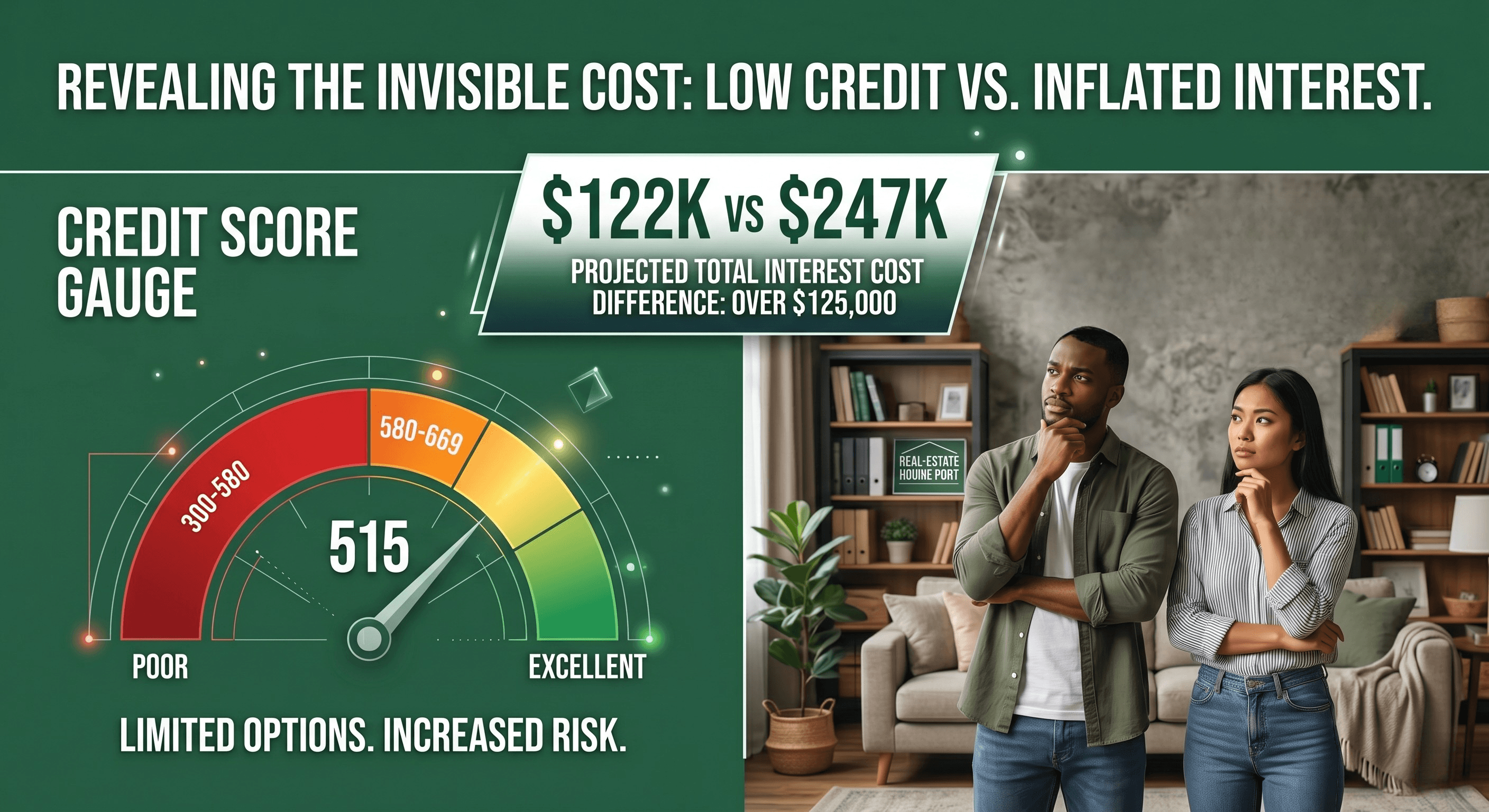
Most people understand that a higher credit score is better. Fewer people understand how much money the difference actually costs you in dollars, over time, on a Canadian mortgage.
Let's make it concrete.
The Lender Tiers That Determine Your Rate
In Canada, your credit score doesn't just nudge your rate up or down a fraction of a percent. It determines which category of lender will work with you and each category operates in a completely different rate band so it can make a huge difference.
A-Lenders (banks and credit unions)
This is where the best rates live. Most major banks require a minimum score of 680 for insured mortgages, and 720 or above to access their most competitive products. If your score is 760+, you're negotiating from strength.
B-Lenders (alternative lenders)
These lenders serve borrowers who don't qualify at an A-lender level, typically scores between 580 and 679, or borrowers with income documentation issues. Their rates run roughly 1–2% higher than A-lender rates, plus an origination fee that's often 1% of the mortgage amount.
Private Lenders
Private lenders don't have hard score cutoffs, but they price for risk aggressively. Rates start around 8–10% and can go higher, with fees of 2–4% at closing. These are short-term bridge solutions and definitely not a place you want to stay.
What the Numbers Actually Look Like
Let's say you're financing a $650,000 home with a 20% down payment — a $520,000 mortgage.
| Credit Profile | Lender Type | Rate (5-yr fixed) | Monthly Payment | Total Interest Paid (5 yrs) |
|---|---|---|---|---|
| 760+ | A-Lender | 4.89% | $2,980 | $122,400 |
| 680–719 | A-Lender (floor) | 5.39% | $3,125 | $135,200 |
| 600–679 | B-Lender | 6.79% | $3,468 | $171,200 |
| Below 600 | Private | 9.50% | $4,325 | $246,700 |
The gap between a strong A-lender borrower and a private lender borrower: over $124,000 in interest across five years on the same house, for the same purchase price.
That number tends to land differently than "your score needs to be higher."
The Stress Test Compounds the Problem
Here's what most borrowers miss: it's not just your rate that changes based on your credit score. It's your qualifying power.
Under OSFI's Guideline B-20, all federally regulated lenders stress test your mortgage at your contract rate plus 2%, or 5.25%, whichever is higher. If a B-lender is offering you 6.79%, you're being stress tested at 8.79%.
That shrinks the maximum mortgage you qualify for, sometimes dramatically. Borrowers who think they're close to purchasing often discover that their actual buying power, stress-tested at a B-lender rate, is tens of thousands of dollars less than they expected.
A-lenders stress test at much lower floor rates. The score you carry into your mortgage application determines the rate, and the rate determines what you can actually buy.
What Score Do You Actually Need?
For most Canadian banks and credit unions, the practical thresholds look like this:
The difference between 679 and 680 isn't academic. It's the difference between an A-lender product and a B-lender product, often 1.5% on your rate and thousands of dollars in origination fees.
The Timeline to Get There
Credit scores don't rebuild overnight so don't let anyone sell you on quick fix credit repair, but they do rebuild predictably. Most borrowers improving from a damaged or thin credit file can reach the 680–720 range in 18–36 months with a consistent strategy:
The challenge is that most people try to do this while also saving a down payment, while also finding a place to live. All simultaneously. That's where the timelines stretch and the frustration compounds.
How Rent-to-Own Changes the Equation
A rent-to-own program lets you lock a home and a purchase price today, then use the program term, typically two to four years, to build your credit deliberately while living in the property.
At Clover Properties, tenant-buyers enter the program with a clear mortgage qualification target. Monthly payments are calibrated to the stress-tested qualifying rate, so the budget you're practicing with is the budget that will work at term end. Equity credits accumulate toward your down payment. And your credit file has time to strengthen without the pressure of a moving deadline.
When you exit the program, you're not hoping a lender says yes. You're arriving with the score, the history, and the down payment that puts you squarely in A-lender range.
The goal was always homeownership. The program is just a better path to get there.
Related Articles
You're Closer to Owning Than You Think
Most Canadians overestimate how far they are from homeownership. Here's why the gap is smaller and more solvable than you've been told.
What Is Causing the Housing Issues in Canada?
Canada's housing problem is really three problems at once. CMHC data on first-time buyers, stressed mortgage holders and seniors shows why.
Rent-to-Own vs Renting and Saving: Which Path to Homeownership Is Right for You?
Choosing between a rent-to-own agreement and traditional renting while saving for a down payment can significantly impact your path to homeownership. This comprehensive guide breaks down both options to help you make an informed decision.