
What Is Causing the Housing Issues in Canada?
Canada's housing problem is really three problems at once. CMHC data on first-time buyers, stressed mortgage holders and seniors shows why.
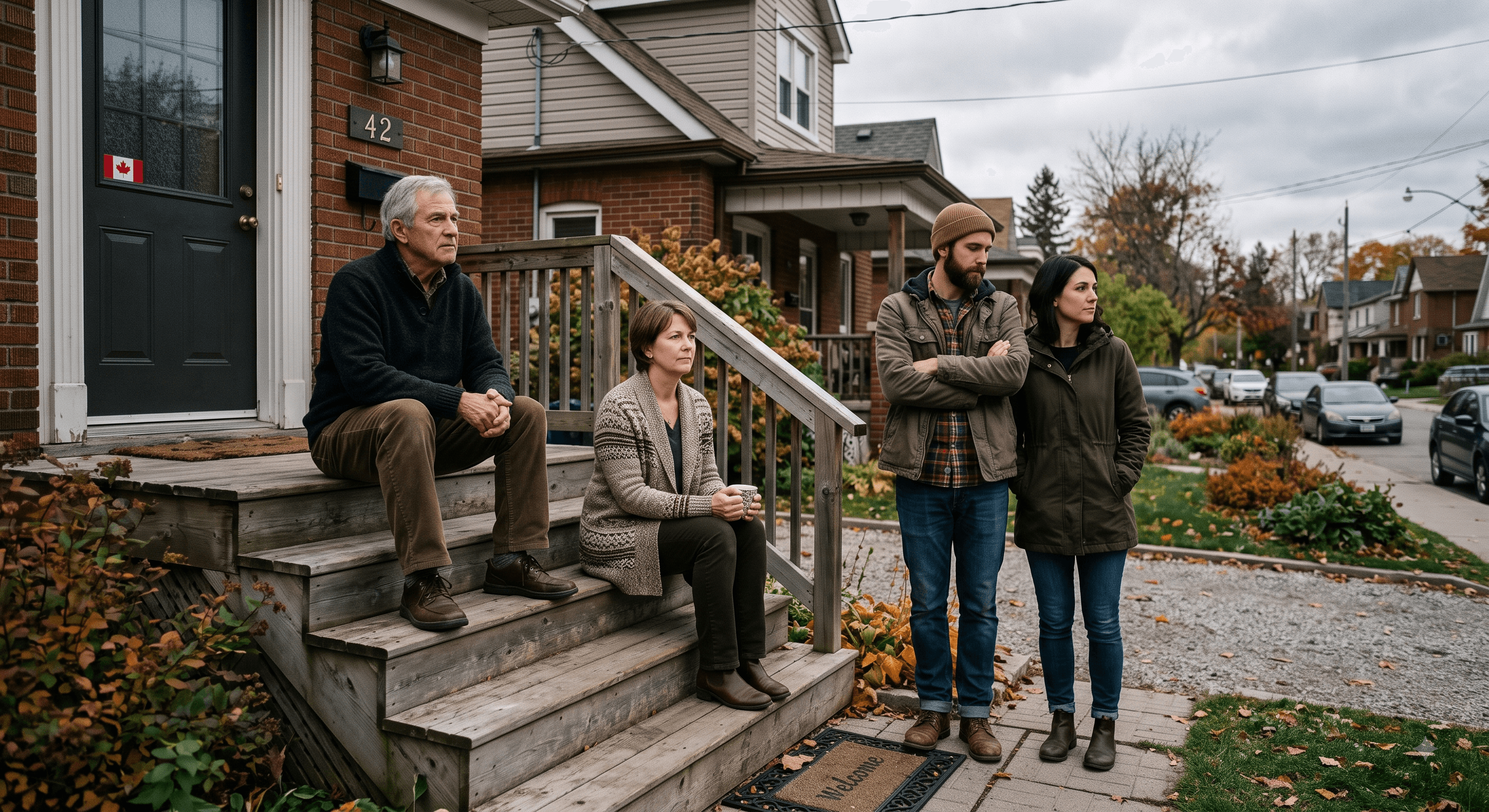
Canada's housing market is being shaped by three very different groups at the same time: first-time buyers trying to get in, older homeowners considering downsizing, and existing mortgage holders dealing with higher housing costs due to interest rates increasing from when they first purchased their home. The numbers show that the challenge is no longer simply "Can Canadians afford to buy?" It is increasingly "Can Canadians enter, remain in and successfully transition through homeownership?"
> Quick Answer: Canada does not publish one real-time number showing exactly how many first-time buyers, downsizers and financially stressed homeowners exist at any given moment. The best national data, however, paints a clear picture.
>
> In CMHC's 2025 Mortgage Consumer Survey, 12% of mortgage consumers were first-time homebuyers, up from 10% in 2024. Among first-time buyers, 64% had previously been renters and they had rented for an average of 6.3 years before purchasing. 6.3 years. That's a lot of money going to a roof over your head without any stake in the property.
>
> At the other end of the housing cycle, Canada had 8.1 million people aged 65 and older in 2025, representing 19.5% of the population. Yet CMHC says downsizing remains a minority behaviour: most younger seniors continue to live in their house, with selling and downsizing becoming more common only at more advanced ages.
>
> Meanwhile, financial pressure among existing mortgage holders is significant. In CMHC's 2025 survey, 51% reported difficulty maintaining debt payments, 14% said they had missed a mortgage payment, and 53% were concerned about possibly defaulting in the future. Actual serious mortgage delinquency remains much lower: 0.24% of mortgages nationally were 90+ days delinquent in Q4 2025.
>
> That creates a Canadian housing market with substantial pressure at every stage of homeownership.
How Many First-Time Homebuyers Are There in Canada?
There is no single current government statistic that says, for example, "Canada had exactly X first-time buyers in 2025."
That is partly because different datasets measure different things: people, households, properties, mortgage transactions and MLS transactions.
The best recent national indicator comes from CMHC.
Its 2025 Mortgage Consumer Survey found that among recent mortgage consumers:
The increase in first-time buyer activity is important because Canada's overall resale market recorded 470,314 MLS residential transactions in 2025. The CMHC percentage should not simply be multiplied by that total as the two datasets measure different populations but together they demonstrate that first-time buyers represent a very significant segment of the Canadian housing market.
There is also evidence of a large pipeline of Canadians preparing to become first-time buyers. The federal government reported that nearly one million Canadians had opened First Home Savings Accounts by late 2024, while CRA's earliest detailed statistics showed 739,000 people had already opened FHSAs by the end of 2023.
How long are first-time buyers renting before they buy?
This may be the more important statistic.
CMHC found that 64% of first-time homebuyers had been renting before purchasing, and those renters had spent an average of 6.3 years renting before becoming homeowners.
Among those previous renters:
That suggests Canada's first-time-homebuyer challenge isn't simply about desire.
There is a considerable period between wanting to own and being financially able to qualify for ownership.
What Is Preventing First-Time Buyers From Buying Sooner?
The down payment remains one of the biggest hurdles.
CMHC found that homebuyers needed an average of 3.4 years to save their down payment in 2025. Among first-time buyers, 41% used a gift or inheritance toward their purchase, with an average gift of $74,570 among those receiving one.
This creates an important distinction.
There are Canadians who cannot afford homeownership, but there is also a different group who may be able to afford the monthly cost of ownership yet cannot currently satisfy the bank's mortgage formula because of their down payment, credit profile, debt ratios, income history or another temporary qualification issue.
Those two groups should not automatically be treated the same.
Canada's Housing Problem Is Actually Three Housing Problems
Looking at these groups together reveals something that gets lost in discussions about housing affordability.
1. Canadians trying to get into homeownership
They may spend years renting and accumulating savings before qualifying. CMHC's first-time buyers who previously rented waited an average of 6.3 years.
2. Canadians trying to remain homeowners
More than half of mortgage consumers surveyed by CMHC reported difficulty maintaining debt payments, even though actual serious mortgage delinquency remained below one-quarter of one percent nationally.
3. Canadians deciding how to exit or transition from their current home
Canada now has more than 8.1 million people aged 65+, but most younger seniors continue to age in place instead of immediately downsizing.
These three groups are connected.
The home an older Canadian eventually sells may become the home purchased by a family moving up or the property a first-time buyer hopes to enter.
The homeowner who becomes unable to sustain a mortgage payment may decide to sell.
And the renter trying to become a buyer may have enough income to carry a mortgage but still be missing one piece of the qualification puzzle.
Is Renting and Waiting the Only Option for Someone Who Cannot Qualify Today?
No.
A mortgage decline answers one question:
Can this borrower qualify for this mortgage under this lender's requirements today?
It does not necessarily answer:
Can this household realistically become a homeowner?
Depending on the reason for the decline, potential paths can include increasing the down payment, repairing credit, reducing debt, establishing more income history, using an insured mortgage, working with an alternative lender, purchasing at a lower price point or using a structured alternative-homeownership program.
The appropriate solution depends on why the traditional mortgage is unavailable and whether there is a realistic path to conventional financing later.
> The starting point should therefore be affordability, not the house.
What Do These Numbers Mean for Canada's Housing Market?
Canada isn't facing one housing affordability challenge.
It has a housing transition challenge.
There are first-time buyers trying to enter.
There are middle-aged homeowners managing larger mortgage obligations.
There are seniors deciding whether to age in place, downsize, rent or unlock the equity accumulated in their homes.
And each group affects the next.
For first-time buyers, the challenge is often getting enough capital and meeting lender qualification requirements.
For existing homeowners, it is maintaining affordability through changing interest rates and life circumstances.
For older homeowners, the question becomes whether their current property still fits their financial, physical and lifestyle needs.
Understanding those transitions may be more useful than simply asking whether Canadian home prices are going up or down.
Frequently Asked Questions
How many first-time homebuyers are there in Canada?
There is no single official real-time national headcount. CMHC's 2025 Mortgage Consumer Survey found that 12% of recent mortgage consumers were first-time homebuyers, up from 10% in 2024.
How long does the average Canadian first-time buyer rent before buying?
Among first-time buyers who previously rented, the average was 6.3 years in CMHC's 2025 survey.
How many Canadians are downsizing?
No authoritative source currently provides a single annual national downsizer count. CMHC describes downsizing as an increasing consideration as Canadians age, but says it still occurs among a minority of senior households and is concentrated more heavily among advanced age groups.
How many seniors are there in Canada?
Canada had approximately 8.1 million people aged 65 and older as of July 1, 2025, representing 19.5% of the population.
How many Canadian homeowners are struggling with mortgage payments?
In CMHC's 2025 survey, 51% of mortgage consumers reported difficulties maintaining debt payments, 17% specifically reported difficulty maintaining mortgage payments and 14% said they had missed a mortgage payment.
Are mortgage defaults high in Canada?
No. Although they are rising, mortgages 90+ days delinquent represented 0.24% nationally in Q4 2025. Ontario was at 0.27% and Toronto at 0.29%.
What percentage of mortgage holders are worried about default?
CMHC's 2025 survey found that 53% were concerned about potentially defaulting on their mortgage in the future, although actual serious delinquency remained much lower.
Final Takeaway
Canada has millions of people at different stages of the homeownership journey.
Some are trying to get in.
Some are trying to stay in.
Some are preparing to get out of a home that no longer fits their life.
The data suggests the biggest opportunity may be in helping Canadians make those transitions successfully.
For an aspiring homeowner, that means understanding what they can afford today, why they cannot currently qualify and whether there is a realistic plan to get them mortgage-ready.
For an existing homeowner under pressure, it means recognizing trouble before missed payments become serious arrears.
And for an older homeowner, it means evaluating whether aging in place, downsizing or unlocking equity best supports the next stage of life.
Homeownership in Canada is no longer simply about buying a house.
It is about creating a sustainable path into it, through it and eventually out of it.
Ready to see if you qualify? Check out our pre-qualification page to start your journey.
Related Articles
You're Closer to Owning Than You Think
Most Canadians overestimate how far they are from homeownership. Here's why the gap is smaller and more solvable than you've been told.
Rent-to-Own vs Renting and Saving: Which Path to Homeownership Is Right for You?
Choosing between a rent-to-own agreement and traditional renting while saving for a down payment can significantly impact your path to homeownership. This comprehensive guide breaks down both options to help you make an informed decision.
Why Banks Decline Good Buyers: 5 Real Reasons in Canada
Solid income, bills paid on time and still declined? Here are the 5 real reasons Canadian mortgage applications get rejected, and how each one is fixable.